
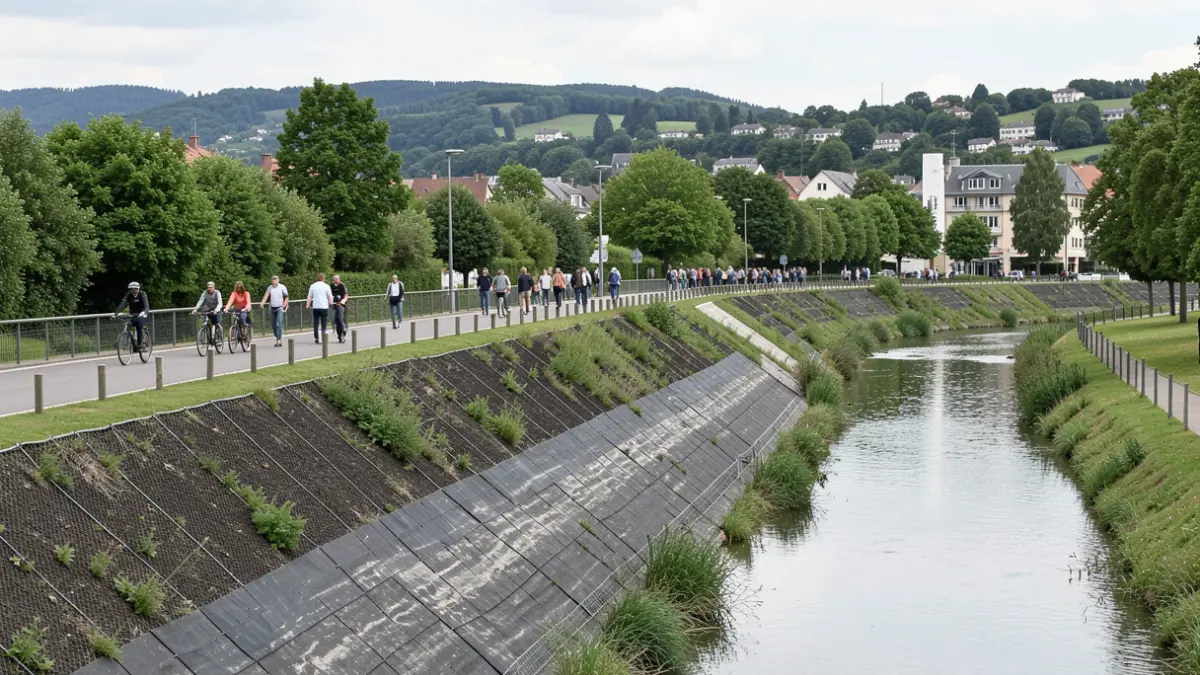
The territory is fortifying itself against flood risks with several projects planned over the next two years. One of these concerns the embankment system in Vaulx-en-Velin and Villeurbanne Saint-Jean. In this district of Villeurbanne, along the Canal de Jonage, the entire embankment will be rebuilt over a 2.5-kilometer stretch in the coming months. Its condition had deteriorated due to vegetation growth, making its stability uncertain in case of a major flood. The future embankment will protect the area from a bicentennial flood, compared to a thirty-year flood currently. A bicentennial flood has a 1 in 200 chance of occurring each year. Nearly 80,000 people could be affected by a major flood in this sector.
The area will be transformed to offer, by 2028, a landscaped promenade while strengthening the district's protection against flood risks. The Métropole de Lyon, in conjunction with river syndicates, has been responsible for the maintenance and monitoring of embankment systems since 2018.
“"The current risk, for both people and their property, is flooding from excessive Rhône river surges, like the one in 2018. This particularly affects the Villeurbanne Saint-Jean district, but also Vaulx-en-Velin and a small part of Décines. The current works are aimed at securing the situation."
The total cost of the works amounts to 14 million euros, including 7.8 million euros for the reconstruction of the Saint-Jean embankment and the promenade development. These works benefit from state support through the Fonds vert (1.2 M€) and the Rhône-Saône plan (5.3 M€ HT).
The work will focus on the embankment structure, the towpath, and the cycle path on Rue du Canal. By 2028, three circulation and promenade areas will be accessible: a pedestrian-only path along the water, a shared cycle and pedestrian path along the crest of the embankment, and a two-way cycle path along with a traffic lane on Rue du Canal. The canal banks, not affected by the works, host important riparian vegetation beneficial for biodiversity.
Scheduled to begin in March, the works on the Saint-Jean embankment will involve rebuilding a lower embankment with fill and installing a waterproof concrete wall to limit water infiltration. Excavated materials will be processed at a facility in Caluire to minimize disruption to residents and then reused on-site to reduce waste. The embankment will be shifted about six meters inward into the Saint-Jean district to preserve the riparian vegetation, move the embankment away from erosion risks, calm traffic on Rue du Canal, and create a promenade and relaxation area along the bank and on the embankment.
Preparatory operations have been underway since mid-October, including the cutting of trees on the embankment under the supervision of ecologists. 'We have marked trees that had the potential to shelter protected species,' assures Delphine Bury, anénagement and biodiversity engineer at the Agence Mosaïque Environnement in Villeurbanne. 'October and November are considered the least sensitive months for intervening with certain species.'
The implementation of the works on the Vaulx-en-Velin and Villeurbanne Saint-Jean embankment system has been carried out in collaboration with the residents of the Saint-Jean district, through guided walks and public presentations. These landscaping developments are part of the urban renewal project for the ZAC Saint-Jean.