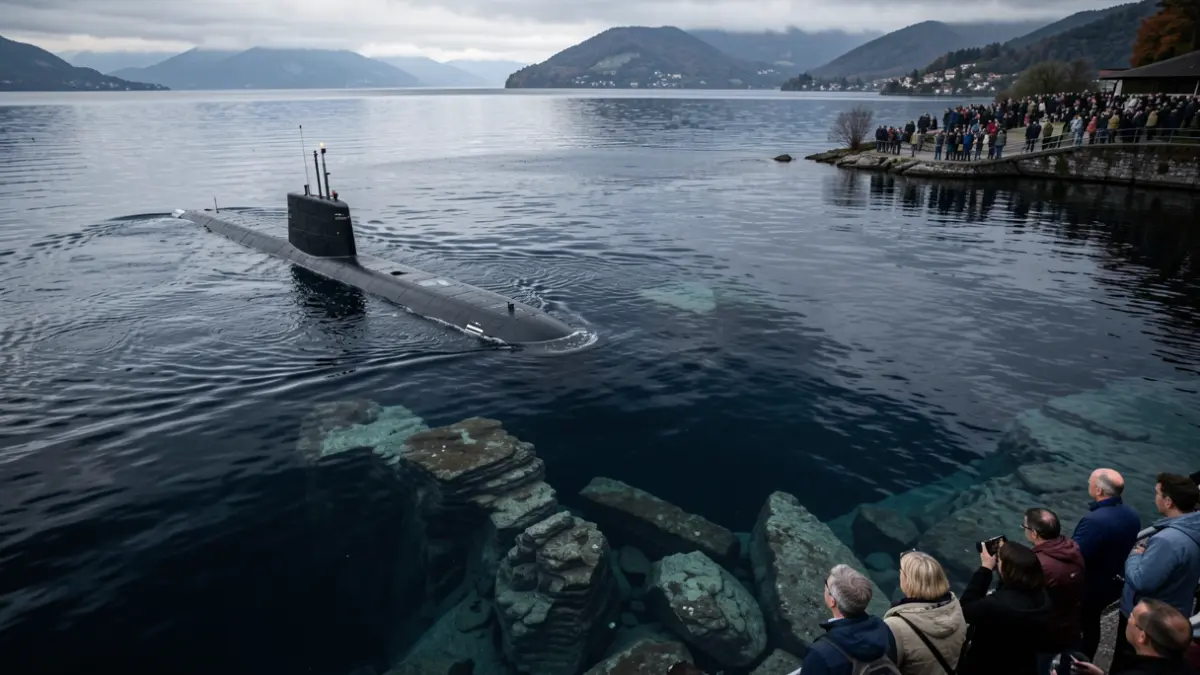
Submarine explorations were conducted in September 2026 in Lake Bourget. Aboard a submersible from the NGO Odysseus 3.1, Pierre Sabatier, a research professor at the EDYTEM laboratory of USMB, participated in this scientific mission. The main objective is to better understand the geological phenomena that can trigger lacustrine tsunamis and to analyze sediments for traces of past events.
Two specific areas of the lake were targeted. The first is linked to an underwater landslide in 1822, which caused a tsunami in the lake. Researchers aim to observe the scar from this landslide and associated deposits. The second area features craters approximately 10 to 15 meters in diameter, interpreted as structures related to fluid upwellings. Sediment analysis suggests a weakness zone dating back about 12,000 years, which could be destabilized by an earthquake.
This research involves multiple teams and laboratories. Within USMB, research engineers from the EDYTEM laboratory are analyzing the data, while the Institute of Earth Sciences (ISTerre) is providing a geophone to listen for gas bubbles. The Laboratory of Mathematics (LAMA) is contributing to the numerical modeling of landslides and tsunamis. Researchers from the Institute of Environmental Geosciences (IGE) at UGA are also involved in gas analysis.
Lacustrine tsunamis, although rare, can be caused by underwater landslides, earthquakes, or rockfalls. A documented example is the Lake Geneva tsunami in 563 AD, caused by a rock collapse, which generated waves up to 8 meters in Geneva. The Lake Bourget tsunami in 1822, with waves of 3.50 meters, also caused the lake to oscillate for four days.
This historical and geological data allows for the calibration of numerical models to simulate landslide and tsunami scenarios, thereby better assessing future risks. This research is being filmed for a documentary by Pascal Guérin on lacustrine tsunamis in the Alps, which will include filming in Switzerland, Italy, and Canada.