
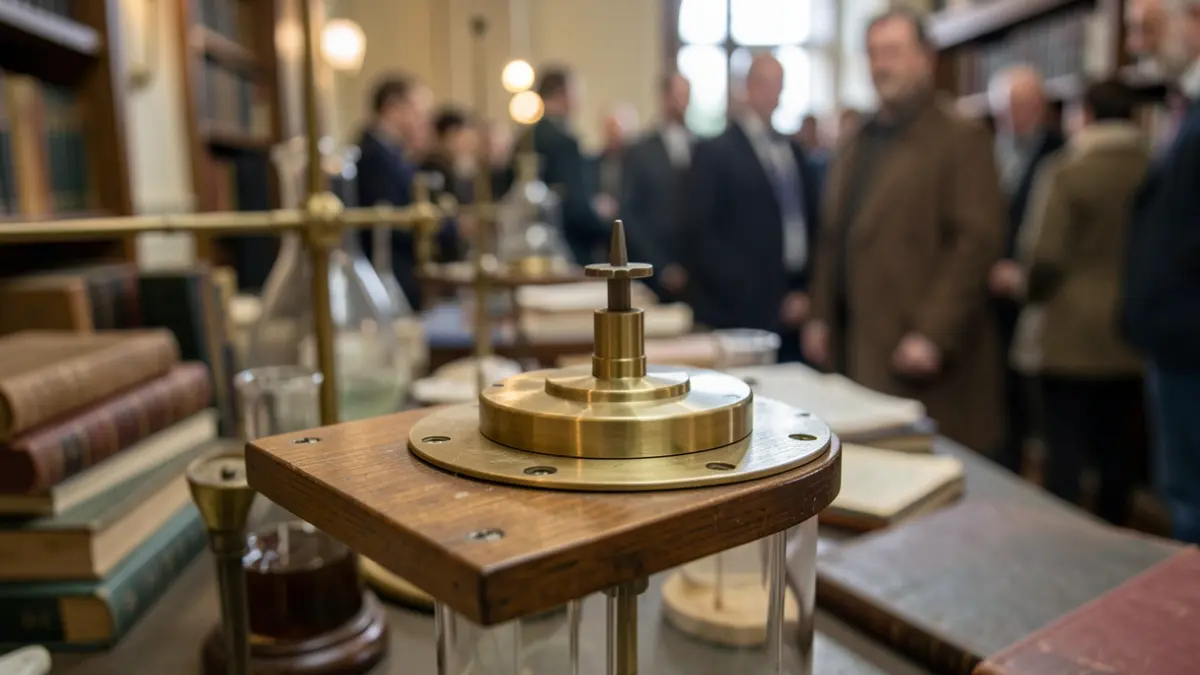
As part of its series "Treasures of Lyon 1 University - Collection Stories," the university showcases the Gaugain apparatus, a remarkable object from the Physics department. This 19th-century instrument made invisible electrical phenomena visible and is key to understanding the history of fundamental physics concepts.
The Lyon 1 Physics collection, preserved since the 19th century and enriched by donations, includes many rare apparatuses for research or teaching. These instruments were used for measurements across various physics fields (electricity, mechanics, optics) and other sciences like physiology or mineralogy.
The Gaugain apparatus, made of brass, wood, and glass (45 cm high, 1 meter long), features two electrodes. Applying an electrical voltage creates an electric arc, more easily in one direction than the other, illustrating how conductor geometry affects this phenomenon. It was used by teachers to make abstract concepts concrete for students.
Named after physicist Jean-Mothée Gaugain (1810-1880), this apparatus reflects the experimental study of electricity when physics was developing as both a theoretical and practical science. It illustrates the mid-19th-century "two-fluid" theory of electricity, predating the discovery of the electron, and is linked to the point effect known since Benjamin Franklin.
Acquired in 1893 for 40 francs from a dealer in antique instruments, the apparatus is listed in the Physics department's records as an "arc apparatus." Its role in the acquisition by Georges Gouy, then head of the physics chair, remains unknown.
This rare piece, with no other known collections holding it, offers an opportunity to rediscover the largely forgotten physicist Jean-Mothée Gaugain, whose work was recognized by James Clerk Maxwell and who helped disseminate Ohm's law in France.