A scientific consortium, including researchers from the Interdisciplinary Physics Laboratory (LIPhy - UGA/CNRS), has uncovered a novel mechanism for liquid foam relaxation after flow ceases. This work, published in October 2026 in Physical Review Letters, promises to enhance our understanding and control of soft materials.
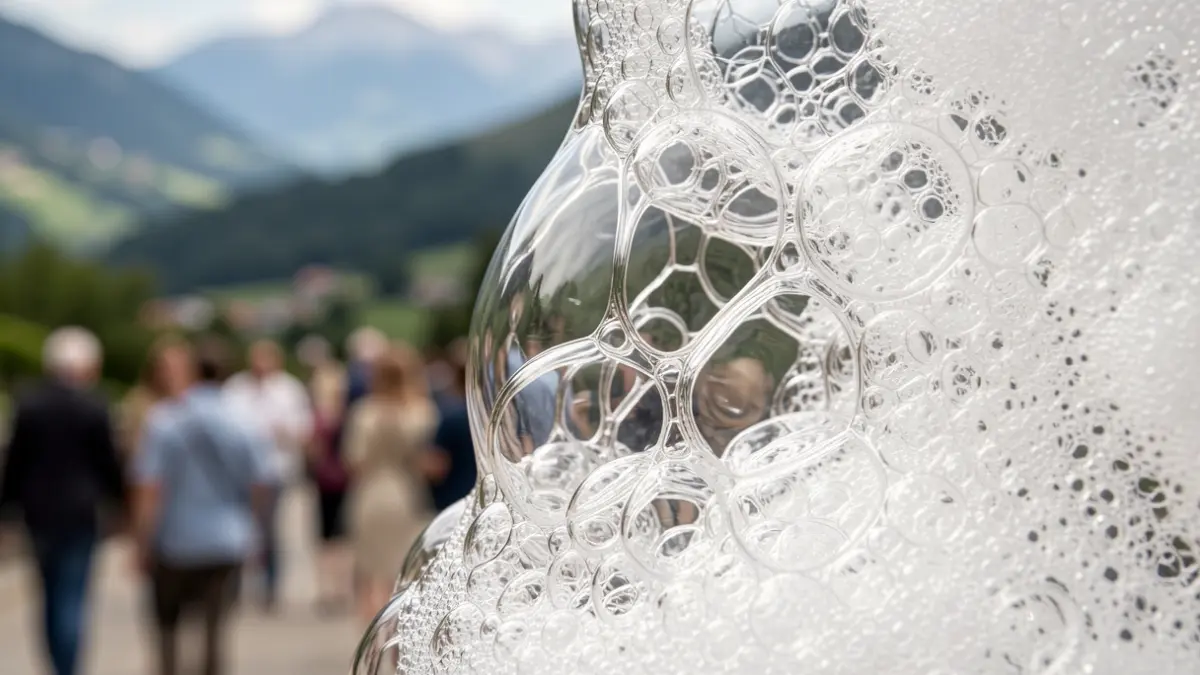
Contrary to the common assumption of immobilization, foams continue to reorganize their bubbles invisibly even when at rest. This phenomenon, observed in various materials like pastes and gels, involves continuous internal structural evolution.
Using rapid X-ray tomorheoscopy, an advanced imaging technique employing a synchrotron, researchers were able to simultaneously observe mechanical stresses and bubble movements. This allowed them to directly analyze the internal dynamics after the flow of an ultrastable liquid foam, used as a model for disordered materials, was stopped.
The results indicate a simple and rapid relaxation, following an exponential law, unlike the slow relaxations seen in other complex systems. Surprisingly, the speed of this relaxation is independent of the foam's prior movement and is directly linked to individual rearrangements at the scale of a few bubbles.
This discovery highlights a regime of relaxation based on a succession of independent local events, rather than large-scale collective effects. It challenges certain hypotheses about the behavior of amorphous materials and opens new avenues for predicting their evolution.
This research could eventually lead to better control over the mechanical properties of materials used in the cosmetic, agri-food, and construction industries, as well as in technological applications. It also offers a renewed conceptual framework for analyzing the influence of mechanical history on the stability of these complex systems.