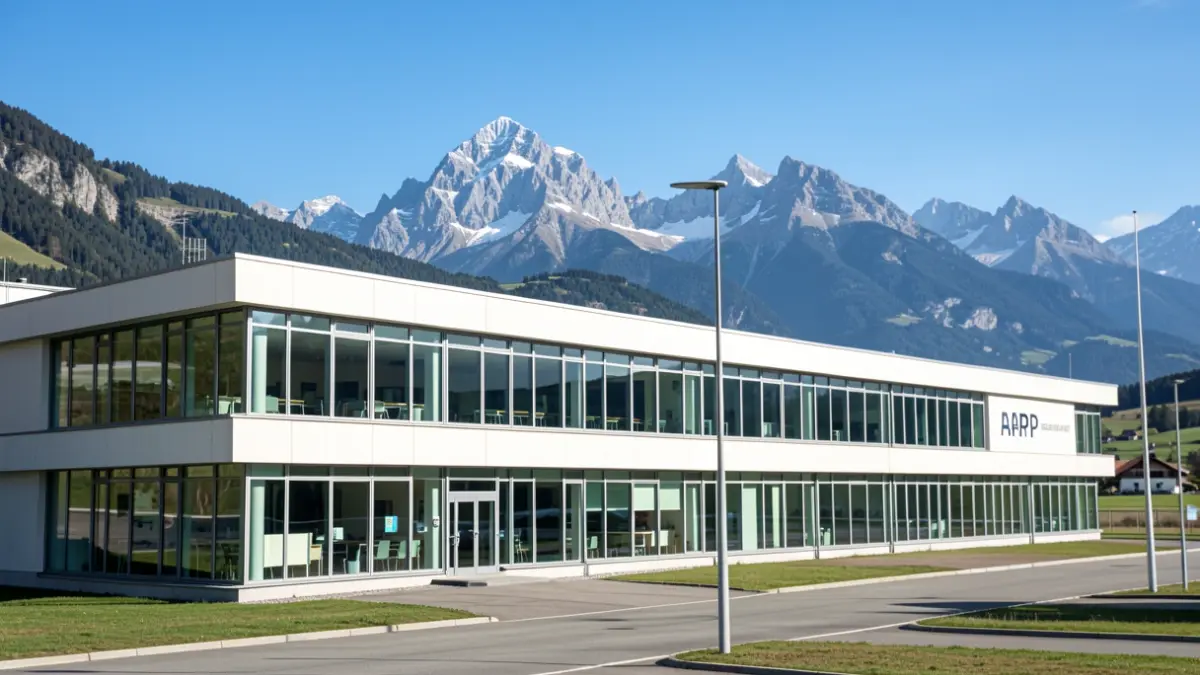
Established with the ambition to bring particle physics research closer to CERN, LAPP now has nearly 160 staff members. It participates in major international scientific collaborations, exploring both the infinitely small with experiments like ATLAS and LHCb at CERN and DUNE in the United States, and the infinitely large through projects such as Virgo, the CTAO telescope network, and the Vera C. Rubin Observatory.
The laboratory's expertise, spanning mechanics, electronics, IT, and administration, has contributed to significant breakthroughs, associated with four Nobel Prizes in Physics, notably for the discovery of the W and Z bosons, the Higgs boson, and gravitational waves.
Vincent Poireau, director of the laboratory since July 2026, emphasized the importance of LAPP for both global science and its local territory, highlighting its connections with training at the University Savoie Mont Blanc (USMB) and its knowledge-sharing initiatives.
Since 1995, LAPP has been a joint research unit under the supervision of the CNRS and USMB. Philippe Briand, president of USMB, recalled how this partnership has energized university research through the laboratory's international reach. The upcoming opening of a physics master's program on the Annecy campus will further strengthen the link between research and education.
The anniversary day also featured presentations tracing the laboratory's history, current scientific concepts, and future projects, blending science, history, music, and artistic creation, followed by a public conference on the history of the Universe.
The 50th-anniversary celebrations continue with open days on October 3rd and 4th, 2026, coinciding with the Fête de la Science, offering an opportunity to discover the laboratory's history and its engagement with society.