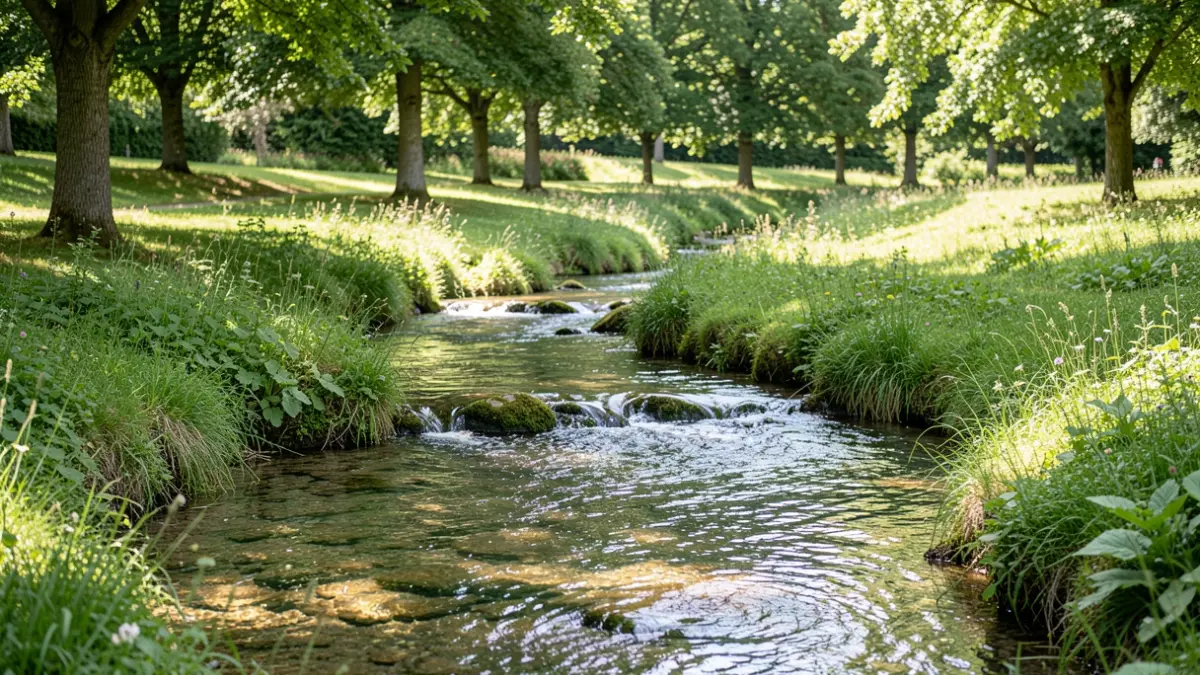
The discreet Sanzy stream, an affluent of the Yzeron, plays a crucial role by never drying up, even during droughts. However, it tended to overflow, flooding its surroundings, including the Sanzy park playground, during minor floods. This was due to significant artificialization of its bed for landscape purposes.
Since last spring, the Intercommunal Syndicate of the Yzeron Basin (Sagyrc) has been undertaking work to renature the watercourse, on behalf of the Métropole de Lyon and other partner local authorities. The stream, which previously flowed in masonry walls upstream and then in a concrete channel along the park, will soon meander freely.
This operation serves multiple purposes: by allowing the Sanzy to better irrigate its surroundings (up to 10 meters wide around the stream in urbanized areas, and up to 50 meters upstream), it becomes a refuge for biodiversity again. Furthermore, by allowing it to wander and carve its own bed, the risks of flooding or overflow are reduced, as stormy rains infiltrate the soil better.
The project includes the removal of a water retention basin to transform it into a wetland, as well as the creation of four ponds along the course to welcome the return of animal species such as frogs, newts, and salamanders. Matthieu Hervé, director of Sagyrc, explains that these works improve the environment's capacity to withstand extreme climatic conditions, making it more resilient.
The operation costs approximately 230,000 euros, with 70,000 euros funded by Sagyrc, notably by the Métropole de Lyon. The director comments that this investment is quickly recouped considering the potential destructive floods avoided thanks to this work.
This initiative also provides an opportunity to educate younger generations on the importance of preserving wetlands. In collaboration with the League for the Protection of Birds (LPO), Sagyrc will invite a CM1 class and a CM1-CM2 class from the Jean-de-la-Fontaine school to the stream banks. The objective is for the children to learn more about the fauna and flora of the Yzeron watershed, discover the species living there, learn to protect them, and even contribute to creating a pond. In June, they will share this knowledge with other schools in the area.