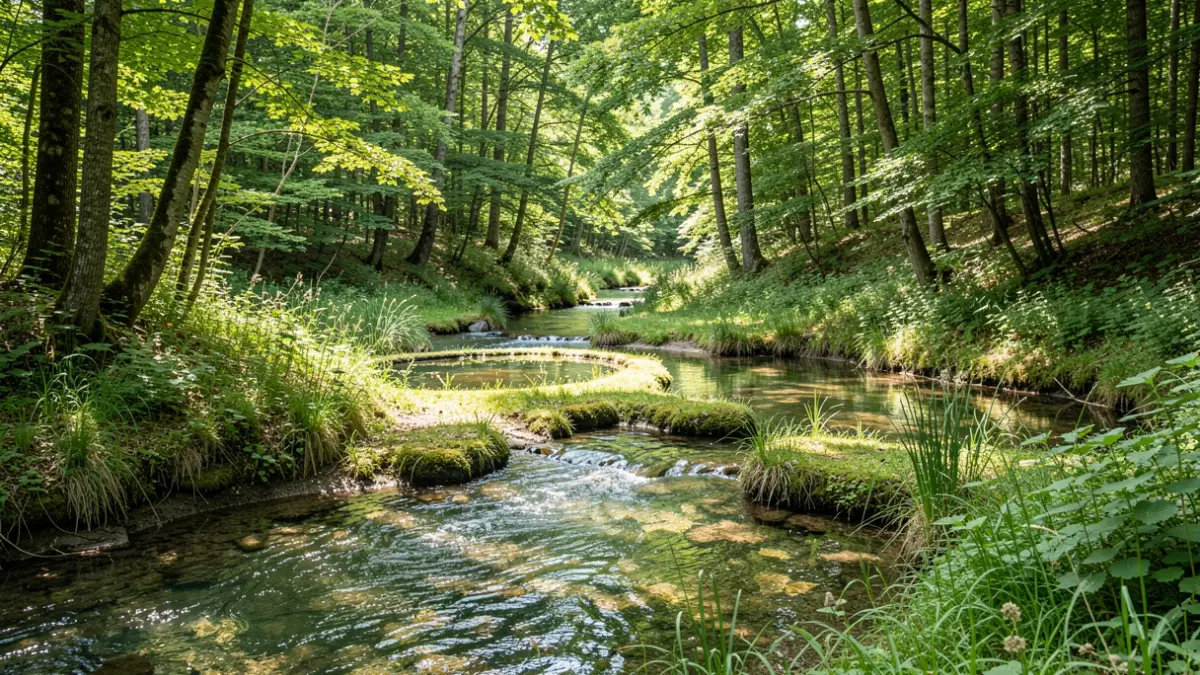
Following an initial phase of work in May, the restoration of the Sanzy has continued in the wood that bears its name in Saint-Genis-Laval. This new stage, now almost complete, gives the watercourse a wider bed and more varied environments, essential for its ecological vitality.
Enclosed in a dense urban environment, the stream, of which 400 meters were culverted downstream, still possessed significant ecological potential. However, successive developments had constrained its bed, accelerated flows, and limited its natural overflow into neighboring wetlands. In the wood, the stream bed was deeply incised for about 150 meters, then channeled into a concrete ditch for an additional 70 meters. These elements have been removed, and the bottom of the bed has been raised to bring it closer to the level of the surrounding land.
The Sanzy now has an average width of 50 meters to evolve naturally and overflow into the adjacent wooded and humid areas. By slowing the water and promoting its infiltration, these developments help to reduce flood peaks and store water in the soil, which will be gradually released during dry periods.
Before the work began, four ponds were dug and planted in the wood to accommodate the amphibians present in the stream, particularly salamander larvae, which are numerous in this area. Their capture and relocation to these refuge habitats were carried out by the LPO, an authorized association. This operation helped to protect the amphibians during the construction period. These ponds will become new favorable environments for amphibians and dragonflies, as well as watering points for small wildlife.
With these two phases of the project, nearly a third of the Sanzy, approximately 450 meters, will have been restored. The next step, planned for November 2026, will involve planting local tree species to complete the restoration and strengthen the vegetation adapted to the site.