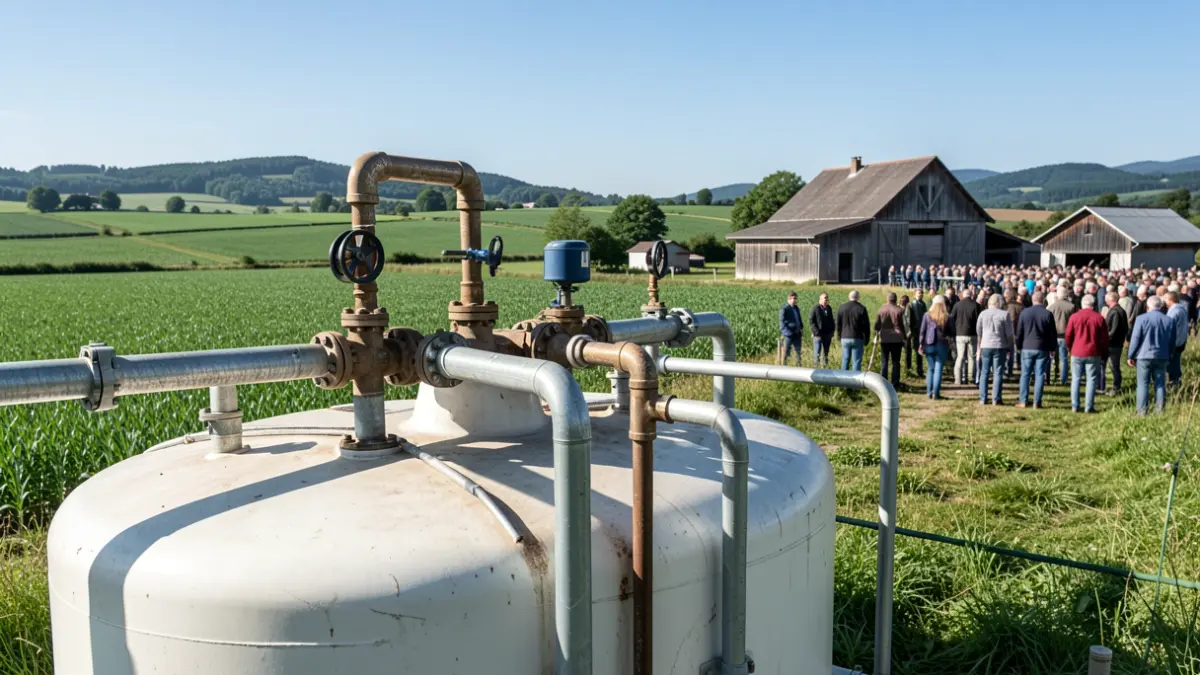
The Méthamoly collective methanization project began in 2012 when twelve farmers, including Aloïs Klein, committed to the initiative. Following a potential study funded by the Communauté de communes des Monts du Lyonnais (CCMDL) in 2011, the group established the company Méthamoly in 2015. Construction started in 2017 in the Croix Chartier area, and in 2019, the first biomethane molecules were injected into the GRDF network.
The farmers' commitment did not stop there. In 2020, the Rhône's first BioGNV station was inaugurated near Méthamoly, a result of a public-private partnership with the CCMDL. This station operates at full capacity, powering buses on lines C202 (Rhône) and C1 (Loire). The price of BioGNV fuel has remained stable for four years, unlike fossil fuels.
To complete its valorization cycle, Méthamoly invested in a CO₂ liquefier in January 2026. This unit captures BioCO₂ from the biomethane production process for use in manufacturing fire extinguishers or in the agri-food industry, such as for brewing beers.
A methanization unit converts livestock effluents, crop residues, and certain agri-food waste into renewable gas and natural fertilizer. In Saint-Denis-sur-Coise, between 17,000 and 19,000 tons of organic matter are processed annually, 60% of which are livestock effluents. The biogas is injected into the GRDF network, used as BioGNV fuel, and generates local electricity and heat. The digestate serves as natural fertilizer for nearly 1,200 hectares.
This initiative aligns with the Positive Energy Territory (TEPOS) strategy of the Communauté de communes des Monts du Lyonnais, which has supported the project from its inception.
“"The fruit of a public-private partnership"