Quantum mechanics, originating about a century ago, has driven technological advancements such as LEDs, MRIs, and lasers. However, its interpretation remains complex and a subject of ongoing discussion, especially among philosophers and specialists.
At the 1927 Solvay Congress, two main viewpoints clashed: the Copenhagen school (Bohr, Heisenberg, Born), which posited a world governed by chance and probability, and Albert Einstein's defense of classical determinism. A third perspective was introduced by French physicist Louis de Broglie, proposing wave-particle duality for matter.
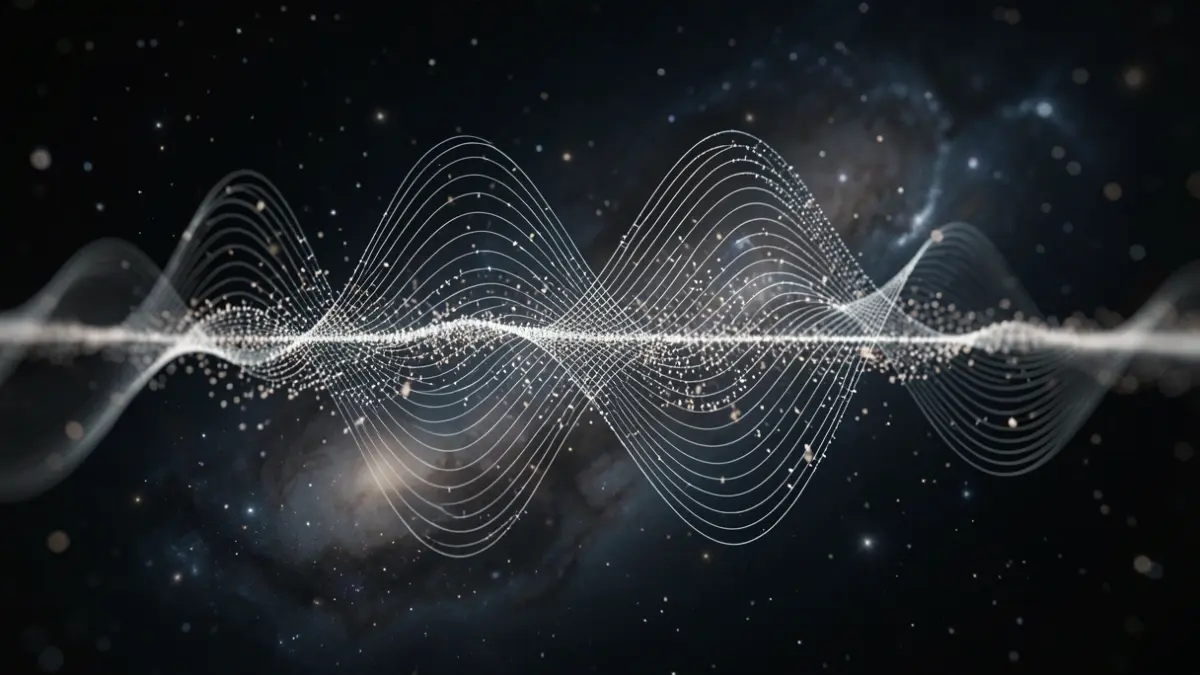
As early as 1923, Louis de Broglie associated a wave with each electron, explaining Bohr's quantized atomic orbits. The double-slit experiment, where single electrons create interference patterns, exemplifies this duality. The Copenhagen school dismissed De Broglie's ideas of classical trajectories as outdated, favoring a more abstract view.
De Broglie's pilot-wave theory, later revived and developed by David Bohm in the 1950s (the dBB theory), offers an intuitive model: particles are guided by a quantum wave, maintaining real trajectories. Despite initial criticism, this approach is recognized as a coherent alternative to the Copenhagen interpretation and helps resolve paradoxes like Schrödinger's cat.
Recently, an experiment by Jan Klaers' Dutch team, published in Nature, appeared to challenge the dBB theory by examining the tunnel effect. The authors interpreted their findings as a refutation, suggesting a zero velocity within the barrier.
However, further analysis by researchers, including those from Université Grenoble Alpes, revealed that the contradiction dissolved. By accounting for the actual optical properties and light leaks in the experimental setup, the dBB velocity was found not to be zero, and the theory aligned perfectly with observations. These findings were subsequently published in the same journal.
The dBB theory has proven robust, consistently reproducing the predictions of standard quantum mechanics. Current debates are now focused on the frontiers of quantum mechanics itself, such as quantum field theory and quantum gravity, where extensions of the dBB theory are being explored.