A battery cell generates heat during operation and changes volume with charge and discharge cycles. To maintain the performance of prismatic cells, a dual function is necessary: heat evacuation and mechanical compression. Traditionally, these functions are handled by separate equipment, such as a cooling plate and compression plates.
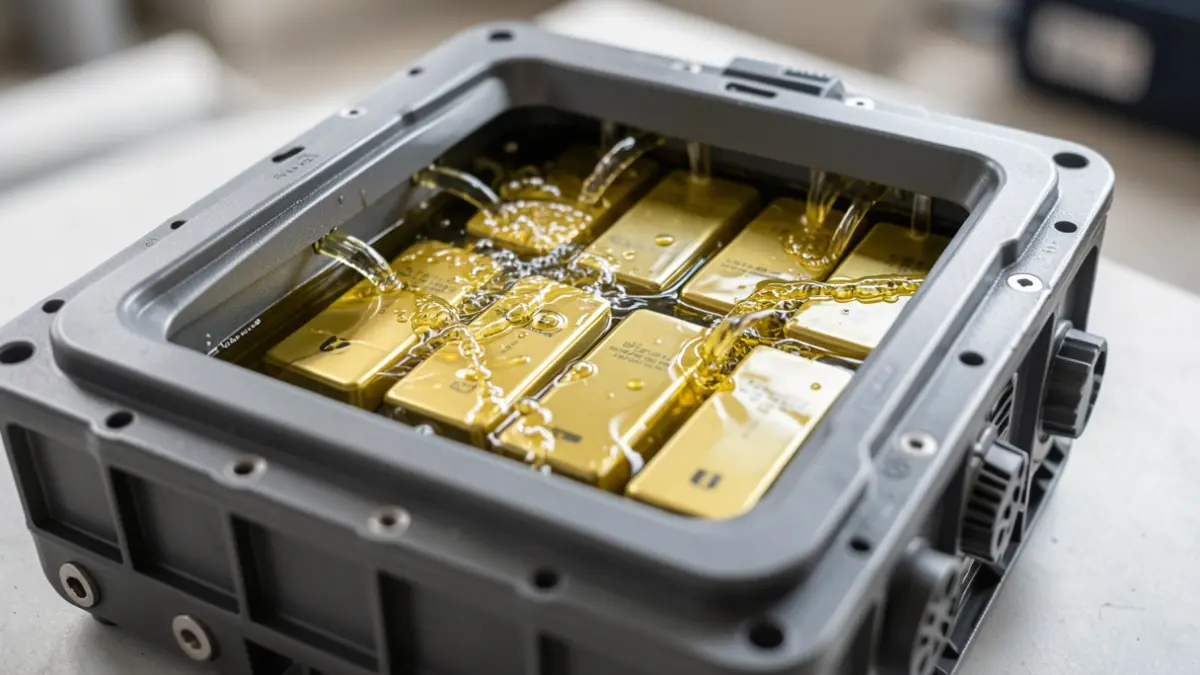
The CEA-Liten teams, within the Horizon Europe NextBat project, have patented a solution that combines these two functions. It involves immersing the cells in an electrically insulating dielectric oil placed under pressure. "The idea was to combine mechanical compression and thermal management using the dielectric fluid," explains Lionel De Paoli.
The designed module integrates fourteen cells for an energy capacity of 3.9 kWh. The fluid circulates between them, ensuring homogeneous cooling of all their faces, including surrounding electrical connections and electronic boards. Maintained at approximately one bar above atmospheric pressure, the oil also exerts homogeneous and controlled compression. Unlike a classic mechanical assembly where applied force increases with cell swelling, this hydraulic system allows for better pressure control despite volume variations. However, the benefit of this compression on aging still needs to be fully quantified.
This approach requires a sealed casing capable of withstanding operating pressure as well as that generated by a potential thermal runaway. Researchers studied this phenomenon on an immersed cell in a reinforced test chamber, feeding numerical models to size the casing and its four safety vents. The spacing between cells and the fluid also aim to limit the propagation of thermal runaway, an objective to be verified experimentally.
Although the addition of oil increases the module's weight, for certain demanding applications, improved cooling could reduce the number of modules needed at the battery scale. "We can afford to put fewer modules in the vehicle because the modules will age less quickly," specifies Sébastien Fiette. Simulations indicate a potential mass saving of up to 18% in certain scenarios, particularly for a hybrid boat making daily rotations.
The mechanical casing fabrication is underway. Tests on the complete modules will allow these projections to be compared with actual performance and the safety of this architecture to be evaluated.